Teaching my
crawlers to bend
Crawler Manager needs a cast of 3D people who walk, run, swing a sword and grip a shield without their skin tearing or their fingers sinking into the handle. Over two days in November 2026 I had Claude test every option I could find for rigging them. Here is the short version first, then everything I found, then every tool and version so you can try it yourself.
The three characters here are test bodies I made before I locked the game's look. They are not the final cast. Everything was measured in Blender with my own test tools, not yet in the game or on a phone.
Part one: the short version
How a crawler
gets made
- 1
A picture becomes a 3D character
Each crawler starts as one picture of them. Tripo H3.1 turns it into a textured 3D model of 60,000 triangles.
- 2
Slim it for the phone
Blender cuts it to 30,000 triangles. The hands keep every triangle they had, because fingers need them to bend.
- 3
Give it a skeleton
My own skeleton (24 bones) is fitted to the body, plus my own hand bones (30, three a finger). Every character gets the same skeleton, so every move fits every character.
- 4
Decide how the skin follows the bones
These are the weights. I try three sets (my own, Meshy's copied across, and half of each) and keep whichever bends best. This step is new from these tests.
- 5
Put the moves on
One library of moves goes on every body: walks, runs, swings, hits, deaths. The hands get grips for a sword, a shield and a staff, and the feet are set on the floor.
- 6
Test it
A body test, a hand test and a floor check score every character the same way. Anything that fails gets fixed or goes back a step.
What it
made
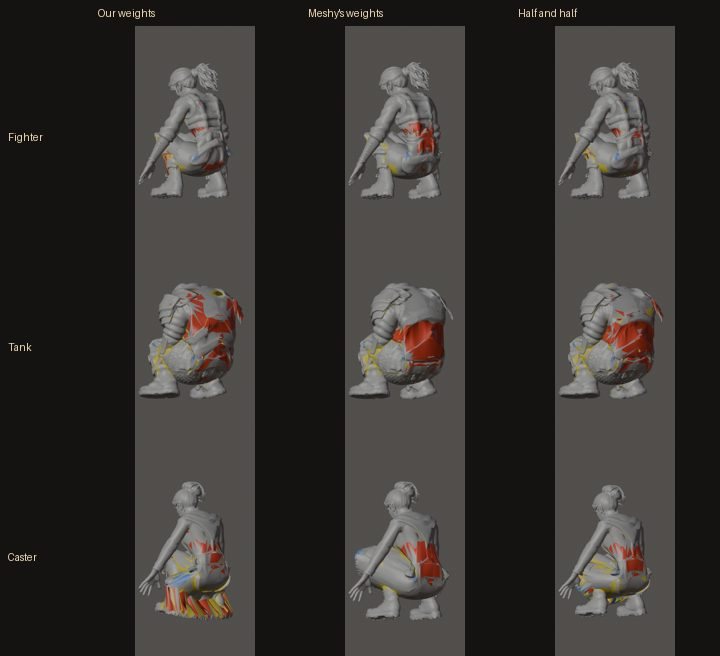
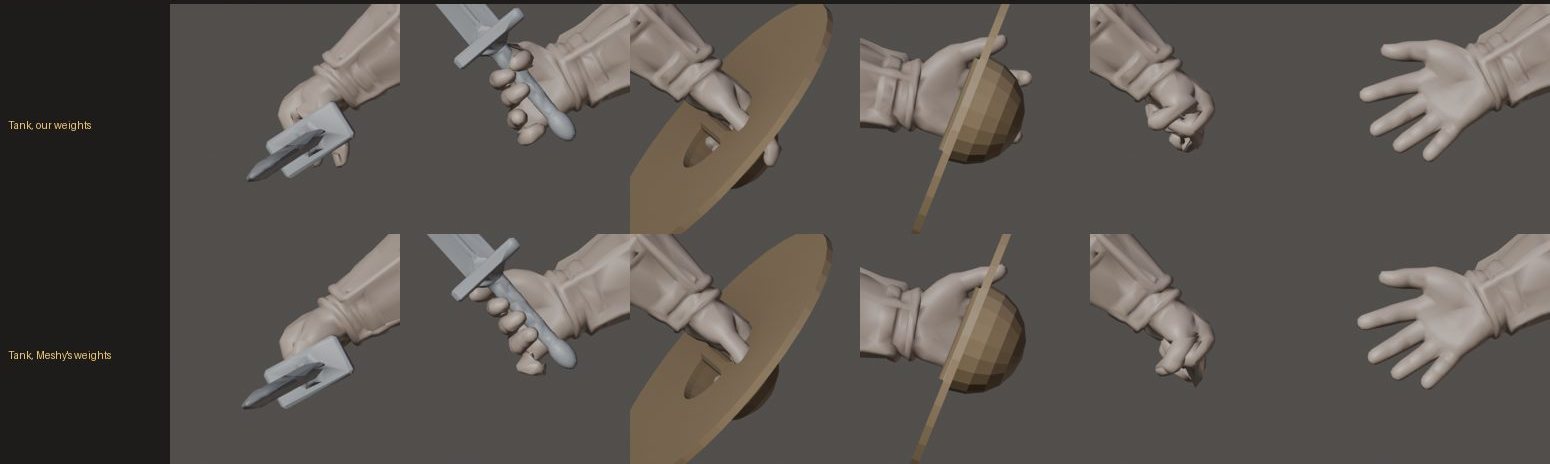
The same skeleton and moves on three very different bodies. Plain grey shows how the skin bends; the stretch pictures show where it stretches too far.
Where everything
ranked for me
On my three characters, by my tests. Your characters and your moves could rank them differently.
| The job | First | Runner-up | Didn't make it |
|---|---|---|---|
| How the skin bends (weights) | It depends on the body, so the test picks. Meshy's weights won the fighter, half and half won the tank, mine won the caster. | Half and half: a clean pass on the fighter and the tank. | Meshy's whole rig with its own skeleton: my moves twisted it. |
| Hands and fingers | My own hand bones, with any of the weightings. | Meshy's weights under my hand bones: fixed the tank's hovering thumb. | Meshy's finger bones: fingers sank 9.4 mm into the handle. |
| Slimming for the phone | My own cut, hands kept dense, with Meshy's weights: the best body I have measured. | My own cut with my own weights. | Tripo's retopology: the hands got half the triangles and failed. |
| Splitting into parts | Tripo's part split: 19 clean, named parts in under a minute. | Nothing else tried yet. | Not ready on its own: nothing exists under the clothes yet. |
Part two: what I found
How I
measured it
A rig is a skeleton inside the model. Move a bone and the body follows. Weights say how strongly each bone pulls each patch of skin. Get them wrong and an elbow folds like paper or a hip stretches like gum.
The body test plays a walk and a run and holds a dozen hard poses, then counts the share of skin triangles stretched past twice their size or crushed under about a third, in the worst frame. Lower is better. Every body is judged by the same standard: pass, pass with fixes, or fails.
The hand test poses the hands (a fist, a sword grip, a shield grip, a staff) through every move in the test and measures overlap in millimetres: a held thing sinking into the palm, fingers sinking into the handle, fingers going into each other, the thumb hovering off the grip. Up to 2 mm is clean, up to 6 mm is fine at broadcast distance, more than that fails.
- The fighter, a woman, 1.70 m.
- The tank, a big armoured orc, 2.00 m.
- The caster, an older woman in a long coat, 1.68 m.
Test 1: Meshy's
finger rig
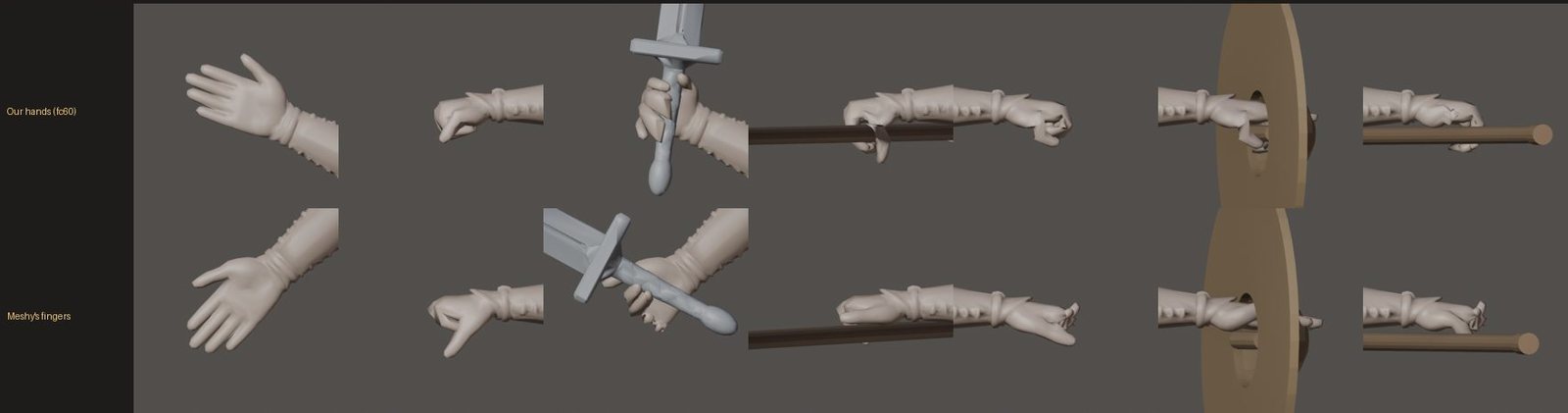
Meshy added finger bones to its auto-rigger on 10 November. Hands are my weakest spot, so two days later I sent it the fighter and put its rig through my hand test.
| Hand measure, worst frame | My hand bones | Meshy's finger bones |
|---|---|---|
| Fingers sinking into what they hold | 3.5 mm, fine | 9.4 mm, fails |
| Fingers going into each other | 6.7 mm, just fails | 10.6 mm in every sword move, 20.5 mm in the wave, fails |
| Held thing sinking into the palm | 1.0 mm, clean | 0.8 mm, clean |
| Hand skin stretched | 10.4 %, fine | 10.9 %, fine |
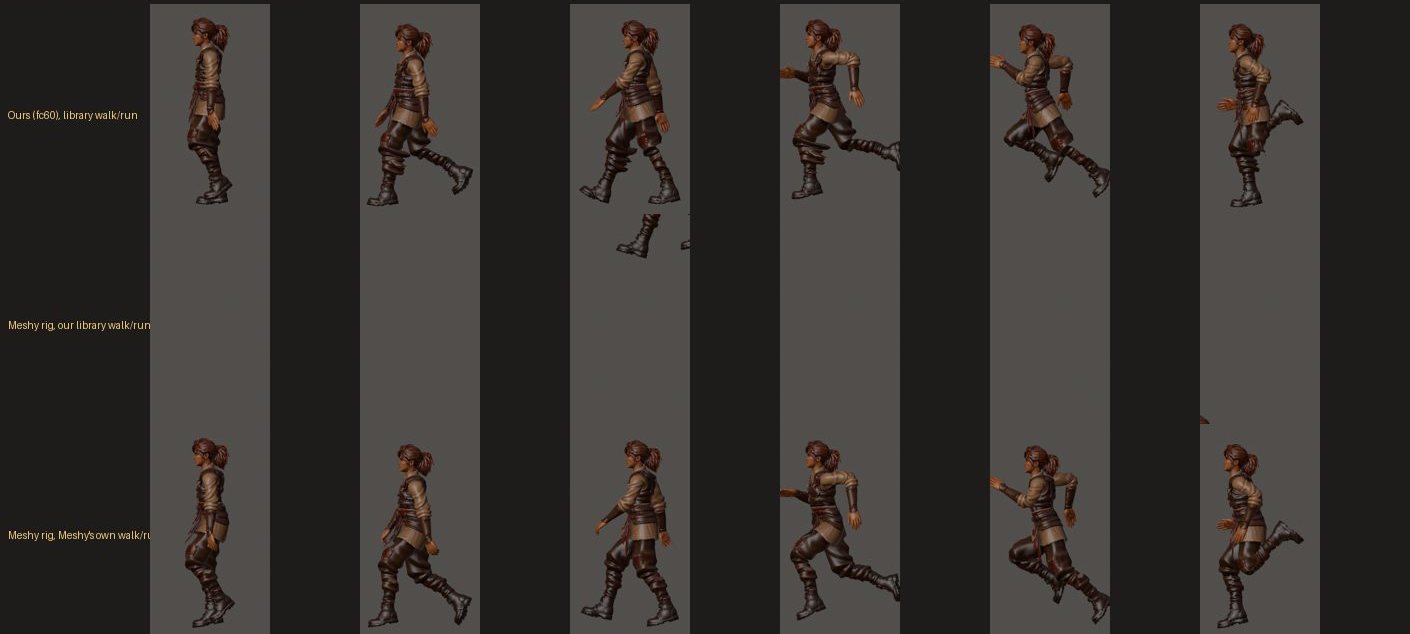
Then the surprise. Meshy's bones have the same names as mine, but they point 4 to 20 degrees differently at rest. My move library is built for my skeleton, so on Meshy's it twisted her hips, wrists and feet, and in the run she walked right out of the camera. On Meshy's own walk and run, the same rig passed cleanly.
| The fighter, 60,000 triangles | Walk | Run | Squat | Verdict |
|---|---|---|---|---|
| My skeleton and weights | 1.9 % | 2.1 % | 6.2 % | Pass with fixes |
| Meshy's rig, my moves | 4.8 % | 6.3 % | 6.1 % | Fails |
| Meshy's rig, Meshy's own moves | 0.5 % | 1.2 % | 6.1 % | Pass |
What I took from it: Meshy's fingers don't beat my hand bones yet, but its weights looked better than mine. So the next test kept my skeleton and borrowed only the weights.
Test 2: three
weightings,
three bodies
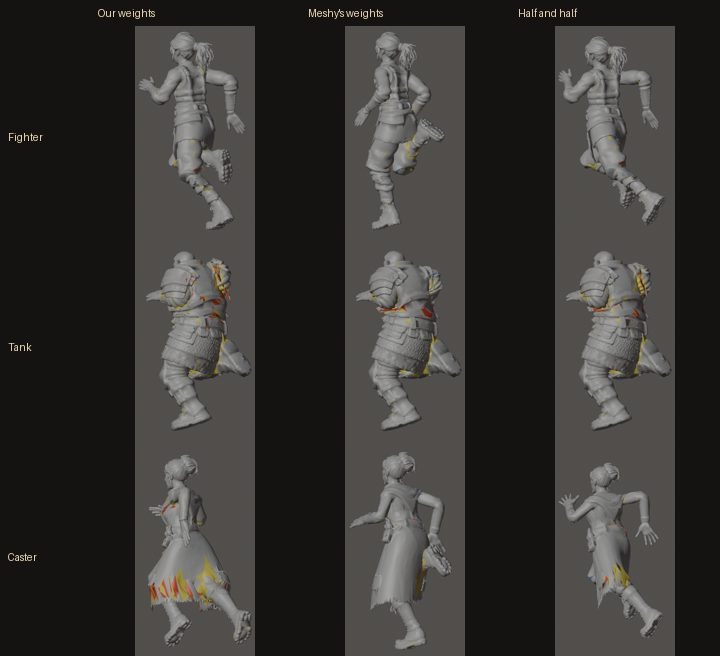
Same skeleton, same moves, same hand bones every time. Only the weights change: my own, Meshy's copied across bone by bone, or half of each blended. All three bodies at the 30,000 triangles the game uses.
| Body and weights | Walk | Run | Squat | Verdict |
|---|---|---|---|---|
| Fighter, mine | 1.7 % | 1.7 % | 5.5 % | Pass with fixes |
| Fighter, Meshy's (kept) | 0.3 % | 0.8 % | 4.6 % | Pass |
| Fighter, half and half | 0.5 % | 1.3 % | 4.7 % | Pass |
| Tank, mine | 1.2 % | 3.1 % | 5.3 % | Pass with fixes |
| Tank, Meshy's | 0.8 % | 2.6 % | 5.0 % | Pass with fixes |
| Tank, half and half (kept) | 0.9 % | 2.4 % | 5.5 % | Pass |
| Caster, mine (kept) | 0.8 % | 1.3 % | 4.4 % | Pass |
| Caster, Meshy's | 0.1 % | 1.5 % | 8.0 % | Pass |
| Caster, half and half | 0.3 % | 1.1 % | 8.1 % | Pass with fixes |
No one weighting won everywhere. Meshy's won the fighter outright. Half and half was the only clean pass on the tank. My own stayed best on the caster, because Meshy's weights nearly doubled the stretch at her hips in the squat. I also tried running Meshy's weights through my own clean-up scripts (the coat rule and joint smoothing). That made them worse on every body, so they work best as they come.
The hands followed the body
| The tank's hands, worst frame | My weights | Meshy's | Half and half |
|---|---|---|---|
| Shield sinking into the palm | 28.0 mm | 8.8 mm | 21.7 mm |
| Fingers sinking into the handle | 24.1 mm | 14.7 mm | 24.1 mm |
| Fingers going into each other | 8.0 mm, fails | 4.8 mm, fine | 8.0 mm, fails |
| Thumb hovering off the grip | 13.3 mm, fails | 0 mm, clean | 0 mm, clean |
The tank is the one real trade-off: half and half gives him the cleanest body, Meshy's alone gives him much better hands. His shield hand still fails either way, just less badly. The caster's hands came out the same with every weighting, and her coat, cut into flaps that swing on spring bones, behaved about the same on Meshy's weights as on mine.
What I took from it: try three weightings on every new character and let the test keep the best. It costs 5 Meshy credits and about half a minute a body, and it can never make one worse.
Test 3: splitting
her into parts
Long term I want crawlers who arrive in their everyday clothes and change what they wear floor by floor. That needs characters made of parts. I tried Tripo's part splitter on the fighter, run through AssetHub on its free plan. It took under a minute.
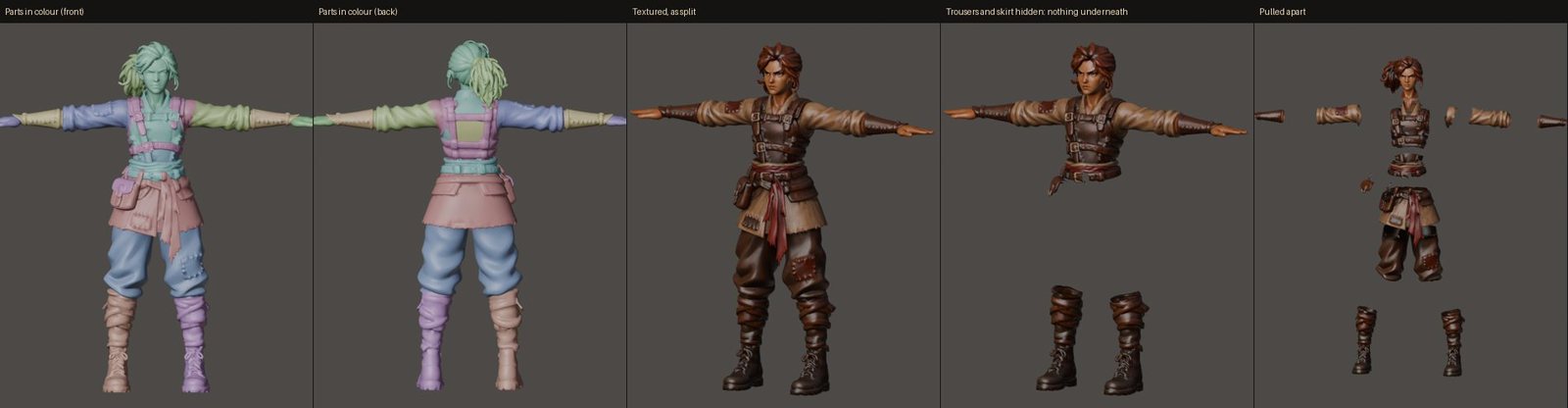
It cut her into 19 clean parts where a person would cut them: head, ponytail, torso, harness, belt, skirt, trousers, each boot, sleeve, bracer and hand, and the pouch. Every part kept its own textures. But the parts are only her surface, cut up. Hide the trousers and there are no legs. Filling in what each part hides is a separate step that costs more than the free plan had left. Tripo's free rig check also called her not riggable.
What I took from it: the splitting half of a modular character works. The filling-in half is still untested.
Test 4: a smarter
cut, or mine?
My bodies start at 60,000 triangles and I cut them down for the phone, keeping the hands dense. Tripo's retopology rebuilds a model more cleanly. Its top setting gave 23,295 triangles, so I cut mine to exactly the same count and ran both through everything.
| 23,295 triangles | Walk | Run | Squat | Body | Hands |
|---|---|---|---|---|---|
| My cut, my weights | 1.6 % | 1.7 % | 5.4 % | Pass with fixes | fingers cross 6.7 mm |
| My cut, Meshy's weights | 0.3 % | 0.7 % | 4.4 % | Pass | fingers cross 6.7 mm |
| Tripo's retopology, my weights | 2.2 % | 3.4 % | 6.0 % | Fails | fingers cross 10.1 mm |
| Tripo's retopology, Meshy's weights | 0.3 % | 0.8 % | 5.0 % | Pass | fingers cross 10.1 mm, skin stretch 17 % |
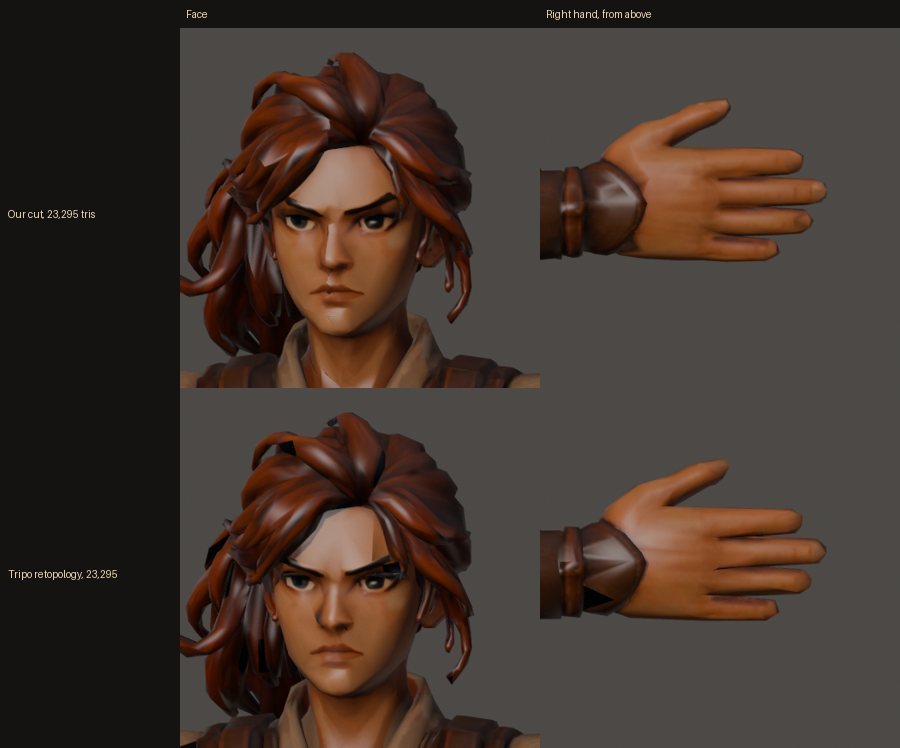
Tripo spreads its triangles evenly, so each hand gets about half as many as mine, and the hands fail. It also came back in 36 loose pieces, and one of my two weighting scripts couldn't weight it at all.
What I took from it: my own cut stays. My cut with Meshy's weights is the best body I have measured: 0.3 % on the walk, 0.7 % on the run.
What broke,
and what's next
- The fighter's fingers still cross by 6.7 mm in the attack with every weighting. Just over the line.
- The tank's shield hand fails with every weighting tried so far.
- In one frame of the fighter's run, the hand test puts the sword through her raised boot with Meshy's weights. I haven't been able to confirm it in a picture yet.
- None of this has been filmed in the game yet. The numbers come first, the film comes next.
Next up is Hyper3D, whose new rigger has finger bones, writes extra bones for coats from a description, and can split a model into parts. I plan to give it the same three bodies and the same tests, and add the results here. Long term, the part I care most about is the creator: crawlers built from parts, so what they find on each floor changes how they look.
Part three: try it yourself
Every tool,
model and version
Everything below is what I used between 12 and 13 November 2026. Makers change their models often, so check the version before you compare your numbers with mine. My test and transfer scripts are my own Blender Python; the measures are described in part two so you can rebuild them.
| Step | Tool, model and version | Settings | Cost |
|---|---|---|---|
| Character models | Tripo H3.1, run through Higgsfield | One picture in, textured GLB out, face limit 60,000 (59,027 triangles came back). Highest settings. | 18 Higgsfield credits a model |
| Cut for the phone | Blender 5.2.0 LTS, my own Python script | Edge collapse to 30,000 triangles (and 23,295 for test 4), the points the hand bones pull locked, weights normalised, normals joined at a 120 degree crease. | Free |
| Skeleton | My own, built in Blender | 24 body bones with Meshy's bone names (Hips, Spine02, LeftUpLeg and so on), fitted to each body and straightened, plus 30 hand bones (three per finger). | Free |
| Meshy's rig | Meshy rigging API, through the Meshy CLI 0.3.0 | include_fingers set to true (added 10 November 2026), height in metres (1.70, 2.00, 1.68). Returns a 66-bone rig: my 24 body bones by name plus four end bones, three bones per finger with a tip bone on four of them, and a free walk and run. | 5 Meshy credits a character |
| Borrowing weights | Blender 5.2.0 LTS, my own Python script | Each point on my body takes the weights of the nearest point on Meshy's (they matched within 0.4 mm), bone by bone by name. Meshy's finger weights fold into the hand. At most four bones a point, summing to one, no other clean-up. | Free |
| Half and half | The same script | Each point's weights are 50 % Meshy's and 50 % my own, then the same tidy. | Free |
| My own weights (the old default) | Blender 5.2.0 LTS | Two ways, and the body test keeps the better: weights carried from a Meshy-rigged copy, or Blender's automatic weights (bone heat) plus my coat rule. | Free |
| Moves | Meshy's walk, run and five library moves, plus Quaternius Universal Animation Library (CC0) | Bought once on one body (3 Meshy credits a move), then carried to every body by bone name with the rest poses lined up. Feet set on the floor, walk and run made to play in place. | 15 Meshy credits once, for the whole cast |
| Part split | Tripo part segmentation, run through AssetHub's API | Granularity: balanced. Tripo's rig check (version 2.5) alongside, free. | 65 AssetHub credits (free plan) |
| Retopology | Tripo Auto Retopology, classic, run through AssetHub's API | Face level: high (20,000 faces), triangles. 23,295 triangles came back, rescaled to one unit tall, so I scaled it back to 1.70 m. | 25 AssetHub credits (free plan) |
The pass lines
- A skin triangle counts as stretched past 2 times its rest area, or crushed under 0.35 times.
- Hand overlaps: up to 2 mm clean, up to 6 mm fine, more fails. Hand stretch: up to 5 % clean, up to 12 % fine.
- The floor check: no foot more than 2 mm under the floor in any frame of any move.
Spent across all four tests: 15 Meshy credits and 90 of AssetHub's 100 free credits. The character models were made earlier.
What I learned,
on a coaster
Two days of tests, small enough for a bar coaster.
RIGGING, ON A COASTER

1. Keep my own skeleton.
   My moves are built for it.

2. Borrow the weights.
   How hard each bone pulls
   the skin. Makers are good
   at this part.

3. Try three weightings on
   every body and let the
   test keep the best one.

4. Hands get their own
   triangles. Even spreads
   starve the fingers.

5. A split is not a wardrobe
   until the body under the
   clothes exists.